


The Montessori Education Method – A Foundation for Nurturing the Whole Child
The Montessori approach supports the holistic and natural development of the human being. It provides a broad vision of education, often described as an "Aid to Life." Today, there are over 22,000 Montessori schools worldwide, serving children of various age groups.
The Association Montessori Internationale (AMI) – Preserving and Advancing Montessori Philosophy
The Association Montessori Internationale (AMI) was established in 1929 by Dr. Maria Montessori with the long-term vision of preserving and advancing the educational philosophy to which she devoted her life. As the leading authority in Montessori education, AMI is headquartered in the Netherlands and maintains a strong collaboration with the United Nations, emphasizing its role not only in education but also in promoting peace and children's rights globally. With over 89 training centers worldwide, AMI upholds the integrity of Montessori principles and practices, ensuring their authenticity even after Maria Montessori's passing.
Montessori Vietnam Education Center (MVEC) – Supporting the Development of the Montessori Method
The Montessori Classroom / The Prepared Environment
The prepared environment is a nurturing space designed to support the physical, emotional, and intellectual development of the child during their formative years. This environment is aesthetically pleasing, orderly, and well-organized, with carefully designed materials and lessons that meet the developmental needs of children in mixed-age groups. The prepared environment includes both indoor and outdoor spaces.
The classroom contains beautifully crafted, child-sized materials that empower children to engage in purposeful work independently, suited to their abilities, interests, and developmental stages. This freedom supports the child's natural drive for exploration and self-construction.
Beyond the classroom, natural outdoor spaces offer children opportunities to connect with nature, such as tending gardens, caring for plants, and developing a sense of responsibility for life.
Children possess an innate passion for learning, and the Montessori environment nurtures this by providing opportunities for independent work under the guidance of a trained adult. Through their activities, children develop focus, self-discipline, and a sense of joyful learning. In an atmosphere of love, respect, and freedom of choice, children progress at their own pace, honoring their unique learning rhythms and capabilities.
The Montessori Teacher
A Montessori teacher undergoes specialized training to deeply understand the Montessori philosophy and methodology. They have a profound knowledge of human development and a keen awareness of the psychological characteristics of the age group they work with. This understanding enables the teacher to communicate with children respectfully and guide lessons that meet the child's developmental needs.
The Montessori Curriculum: Developmental Stages and Programs
The Montessori curriculum is divided into developmental stages based on Dr. Maria Montessori's theory of human development, which outlines four distinct planes of development:
First Plane: Birth to 6 Years – The Absorbent Mind
During this period, children possess the "Absorbent Mind," where they effortlessly absorb knowledge from their environment, including language, culture, and sensory experiences.
Programs for the First Plane:
- Nido (The Nest): Designed for infants from birth to when they begin walking (approximately 8 weeks onward). This environment fosters early independence by supporting the child's first major milestone—learning to walk.
- Toddler Community: For children who have begun walking. It emphasizes the development of gross motor skills, language acquisition, and early independence through practical life experiences. This mixed-age community provides rich opportunities for self-construction and social interaction.
Children's House (3-6 years):
This stage focuses on the child’s self-construction and cultural absorption. The carefully prepared Montessori environment offers materials and activities that nurture curiosity and creativity while supporting language, mathematics, sensorial exploration, practical life skills, and cultural studies.
The Children's House provides a rich cultural curriculum, including materials like globes, maps, songs, land and water forms, and cultural artifacts, fostering an appreciation for the world beyond the child's immediate surroundings.
Second Plane: 6-12 Years – The Reasoning Mind
At this stage, children develop a "Reasoning Mind" and begin to explore the world with abstract thought and imagination.
Montessori Elementary School:
Children work collaboratively in small groups, engaging in project-based learning with the guidance of the Montessori teacher. The curriculum encourages exploration of the universe, human civilization, and cultural understanding. Subjects include geography, biology, history, language, and mathematics, all interconnected with arts, music, and science.
Field trips and experiential learning, such as visits to libraries, museums, botanical gardens, and scientific institutions, allow children to experience concepts beyond the classroom. This comprehensive approach fosters a sense of global interconnectedness and a desire to contribute positively to the world.
Third Plane: 12-18 Years – The Humanistic Mind
Adolescents seek to explore humanity and contribute to society, driven by a "Humanistic Mind."
Montessori Secondary School:
Dr. Montessori recommended that adolescents spend time away from home, engaging with nature and learning about civilization through agricultural work. This concept, called "Erdkinder" (Children of the Earth), encourages practical life experiences such as managing a farm, running a store, and participating in community-based economics.
During this critical phase of adolescence, the focus is on social development, critical thinking, self-reflection, and understanding one’s place in the world.
Fourth Plane: 18-24 Years – The Specialist Mind
Young adults, with their "Specialist Mind," focus on developing expertise and contributing their skills meaningfully to society.
Core Principles of the Montessori Method
1. Respect for the Child’s Natural Rhythms and Uniqueness:
Each child is seen as a unique seed with an innate blueprint and infinite potential. The role of the adult, like a caring gardener, is not to shape the child but to nurture the conditions for natural growth. Montessori emphasizes sensitive periods—windows of heightened receptivity to learning specific skills—and respects each child’s individual pace of development.
2. A Prepared Environment and Guided Freedom:
A Montessori classroom is a thoughtfully prepared space where everything is child-sized and intentionally arranged to support independence. Children move freely and choose activities aligned with their developmental interests. This freedom is balanced by structure and mutual respect, fostering a peaceful and orderly atmosphere.
3. Experiential Learning Through Hands-On Activities:
Learning in Montessori is rooted in direct experiences. Children engage with hands-on materials to explore abstract concepts concretely, such as geometric solids for geometry or counting beads for arithmetic.
4. Self-Discipline and Internal Motivation:
Montessori encourages intrinsic motivation by focusing on personal achievement rather than external rewards or punishments. Children take ownership of their learning, leading to self-discipline and accountability.
5. Holistic Development and Preparation for Life:
Beyond academics, Montessori education nurtures emotional intelligence, social skills, and practical life abilities. It equips children with confidence, independence, and a sense of purpose, preparing them to be compassionate and responsible citizens of the world.


Lastest posts
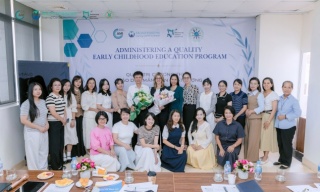
QUALITY EARLY CHILDHOOD EDUCATION PROGRAM MANAGEMENT: FROM VISION TO SUSTAINABLE PRACTICE
A quality early childhood education program is built not only on a sound educational approach, but also on strong leadership, effective management, and a team united by shared values. Let’s revisit the meaningful insights and perspectives shared at MVEC’s...
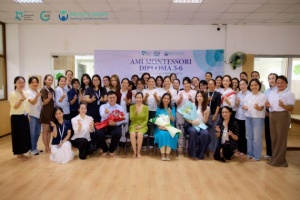
IN-PERSON COURSE OPENING AMI MONTESSORI PRIMARY 3–6 DIPLOMA TEACHER TRAINING COURSE
A new chapter begins as our AMI Montessori Primary 3–6 Diploma students step into their in-person learning journey.
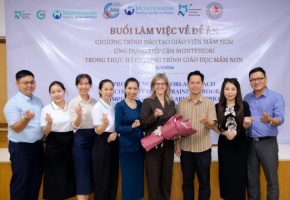
PROJECT WORKING SESSION: TEACHER TRAINING PROGRAM FOR EARLY CHILDHOOD EDUCATORS APPLYING THE MONTESSORI APPROACH IN IMPLEMENTING THE EARLY CHILDHOOD EDUCATION PROGRAM
A meaningful milestone in our journey to bring Montessori into early childhood education in Vietnam.
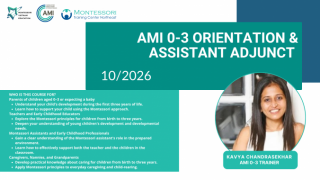
AMI MONTESSORI 0–3 ORIENTATION & ASSISTANT CERTIFICATE PROGRAM
Montessori Vietnam Education Center (MVEC) is now accepting applications for the AMI Montessori 0–3 Orientation & Assistant Certificate Program, designed for parents, educators, caregivers, and anyone wishing to gain a deeper understanding of children's...
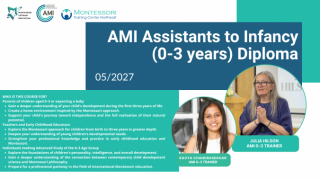
AMI ASSISTANTS TO INFANCY (0–3) DIPLOMA COURSE
The AMI Assistants to Infancy (0–3) Diploma Course, organized by Montessori Vietnam Education Center (MVEC), is designed for individuals who wish to develop a profound understanding of and effectively support the development of children from birth to three...

MS TRAN THANH HIEN
Sustainable educational journeys are built by individuals who continuously learn, lead, and inspire communities. With a deep commitment to the development of Montessori education, MVEC is honored to introduce Ms. Tran Thanh Hien – Training Director of the...

MS NGUYEN THI MY HANG
Every Montessori educator brings a unique journey, philosophy, and approach to supporting children's development. With dedication to early childhood education, a deep belief in children's potential, and a commitment to continuous learning, Nguyen My Hang is...

MS TRAN THI TAI LINH
Every Montessori educator brings a unique journey, belief, and approach to supporting children's development. With a deep passion for early childhood education, dedication to the earliest years of a child's life, and a strong belief in the Montessori...

MS LUU THI PHUONG
Every Montessori educator carries a unique journey, belief, and mission in supporting children's development. With more than 10 years of experience in early childhood education, a strong professional foundation, and a deep commitment to the Montessori...